
 Image 1 of 1
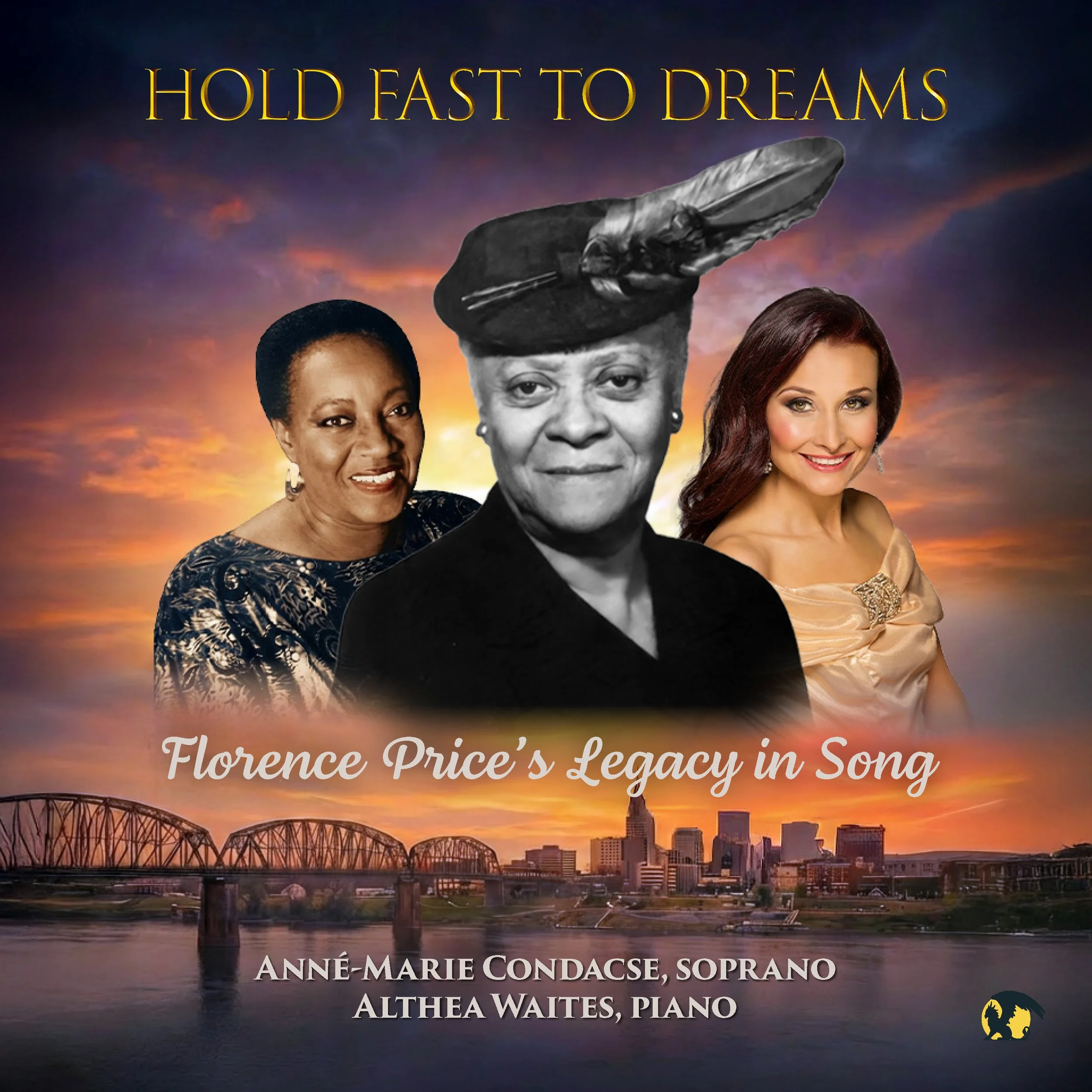
Florence B. Price composed more than 180 art songs between 1926 and 1953, yet was able to publish only a handful during her lifetime. The doors of the white- and male-dominated music-publishing industry were largely closed to African Americans and women, relegating these extraordinary creations to private circulation and archival obscurity. These works—which in quantity, quality, and stylistic diversity rival or surpass those of many canonical white and male composers—were left unpublished, unheard, never taught or studied, and thus unable to claim their rightful place in the canon of classical music.
Hold Fast to Dreams represents an important contribution the ever-growing publication of Price’s music, particularly because the discography of Price’s songs, despite frequent live performances, is still startlingly small.
Versatile Romanian-born lyric soprano Anné-Marie Condacse and legendary Price advocate Althea Waites present a thoughtfully curated cross-section of sixteen art songs that vividly illustrates the inexhaustible richness of Price’s musical imagination, her voracious appetite for poetry by writers both celebrated and obscure, and her sensitivity in reading poems and translating her interpretations into music.
The program explores several overarching themes in Price’s song oeuvre. Many works serve as confessional vehicles—highly personalized expressions that resonated emphatically with Price’s own lived experiences as an African American woman. “Brown Arms (To Mother)” was written twenty years after Price’s mother severed all connections with her daughter to pass as white. “My Little Dreams,” on a poem by Georgia Douglas Johnson, bears the inscription “To the memory of my husband,” Price’s most explicit musical reference to her first husband. “Sympathy,” on Paul Laurence Dunbar’s powerful poem, likens the lyric persona to a caged bird, reflecting on what Price considered the “two handicaps” she faced from birth: those of race and sex.
Other songs celebrate nature as allegory of human existence and experience. “Love-in-a-Mist” puns on the name of the common midwestern garden flower, using complex harmonic language to characterize doubt’s disorientation. “Night” uses rich and sumptuously voiced harmonies to evoke the popular Black Renaissance trope of night as metaphor for blackness’s dark beauty. “Sunset” uses the word “golden” six times in just forty-six bars—an eloquent musical and poetic underscoring of the fact that gold, symbol of wealth and power, is painfully attached to darkness.
The album also features Price’s best-known songs, including her settings of Langston Hughes’s “We Have Tomorrow” and “Hold Fast to Dreams,” the latter giving the album its title. “We Have Tomorrow” seizes Hughes’s spirit of optimism, depicting the poet’s encouragement not to let today’s challenges defeat hopes for tomorrow. “Hold Fast to Dreams” returns to the trope of the bird to encourage—and warn—us that we must dream on, because without dreams life is purposeless.
As noted in the liner notes by John Michael Cooper, “The sixteen songs presented in this album are but a small sampling of the extraordinary, truly dazzling breadth and unrelenting genius of Florence B. Price’s contributions to a genre that was central to her musical imagination, as it is also to the modern canons of classical music generally.”
We have tomorrow (0:58)
Night (1:50)
My Little Dreams (1:16)
Love-in-a-mist (2:50)
God Gives Me You (2:09)
An April Day (1:40)
Youth (0:52)
Brown Arms (To Mother) (3:23)
Strange Borders (3:09)
Sympathy (3:09)
The Glory of the Day was in Her Face (2:36)
Beside the Sea (2:31)
Rhapsody (1:18)
Sunset (1:58)
Beyond the Years (3:42)
Hold Fast to Dreams (1:53)
